
Jinaháa
Megan (Guná) Jensen: Jinaháa
Opening: Thursday, July 24, 2025 4-7pm
July 24 – August 16, 2025
Jinaháa: (verbal noun) fate; taboo / the fate (usually a bad fate) that is sent to one, or to which one is drawn, as a result of one’s actions / in Lingít, this is a terrible fate waiting to fall upon a person or people for violating custom, and it may take generations to arrive.
Ceremonial/Art is thrilled to present Jinaháa by Tlingit artist Megan (Guná) Jensen; a collection of recent works that explore the nature of survivance and will. In Tlingit worldview, Jinaháa is not just “fate.”It is what arrives—sometimes generations later—when something sacred has been violated. It’s not always immediate, but it comes. This show is about that return. Each painting is an invocation and a confrontation. Together they form a ceremony of reclamation.
“What happens when we name the harm?
When we stand in the ruins with our full selves?
When we stop protecting the diggers—and start tending to the graves?
In Tlingit worldview, Jinaháa is not just “fate.” It is what arrives—sometimes generations later—when something sacred has been violated. It is the ancestral and spiritual consequence of harm. It’s not always immediate. Sometimes it takes generations, but it comes. It whispers through bloodlines. It waits in the land. A response from the web of life itself.
This show is about that return, but it’s not about revenge. It’s about truth coming back into the room. It is not punishment—it is a sacred balancing. It’s about those who were silenced, rising to speak. It’s about spirits that were cast aside, coming home. Jinaháa becomes embodied here in the figure of karma herself—walking boldly through histories of extractivism, betrayal, and erasure.
Each painting is both invocation and confrontation. The hearts, the steps, the glitter, the smoke—each mark carries memory and possibility. Together they form a ceremony of reclamation— of grief, beauty, and ancestral knowing. A ceremony that holds contradiction, that whispers while it roars.
This is a show about relational accountability. About what gets disturbed when custom, kinship, and respect are violated— by colonizers, by institutions, by those chasing gold or power. And it’s also about the forces that rises to restore balance. That force lives in Gold Dust Woman. That force stomps through Formline Barbie. That force breathes and burns across every canvas. Guná brings karma to life as a woman—a force walking through history, collecting hearts, burying illusions, and refusing to be silent.
Each piece is an invocation and a confrontation. Together they form a ceremony of reclamation.
This is karma—not as punishment, but as return.
This is Jinaháa.”
– Megan (Guná) Jensen


Installation views of Jinaháa, Ceremonial/Art

Formline Barbie, 2025, 78.25” x 59”, Oil on Canvas
I remember that summer night in 2023 when I first watched Barbie. I wasn’t expecting much—but when Gloria (played by America Ferrera) said, “It’s literally impossible to be a woman,” lightning cracked through my chest. That line—and the film’s layered critique—never left my body. I kept telling myself: Formline Barbie needs to exist.
But it wasn’t until the recent presidential election that she stepped fully into focus. In this vision, Barbie stands fierce in the wreckage of empire. Behind her, President Snow’s mansion crumbles. Beneath her heel, a bright-orange political figure is crushed. But this isn’t nostalgia. This is rebirth. Her skin is painted in Tlingit formline, a living memory inscribed on plastic. Not as ornament—but as resurgence.
The formline itself mimics the gloss and curvature of Barbie’s iconic plastic body, blurring the line between aesthetic construction and the brutal conditions of embodiment. Her surface becomes a tension field—a commentary on the hypervisibility, threat, and legislated violence that marks women’s bodies.
She’s not simply resisting—she is resistance: beautiful, political, and precise.

K’alayéI’ll áwé taayí daa yaa kugáat akawsinei aagáa du s’éigi du leitóoxt uwxíx
The gaslighter wove a nightmare and then choked on their smoke, 2023, Oil on canvas, 48 x 36 in.
The term “gaslighting” was first used in a British play from the 1930’s. The play was called “Gas Light” and was about a husband who mentally and emotionally manipulated his wife into believing she is crazy by changing the intensity of the gas lamps in their home. He was so persistent in denying her reality that he eventually convinced her that she was crazy. The film is very upsetting to watch, as you witness a woman slowly begin to believe she is insane and eventually committed to a mental institution, and the husband steals her inheritance. Gaslighting remains one of the most insidious forms of psychological abuse. Too often we are told we are crazy, when really our intuition knows that something is wrong. In this work, I interrogate the gaslighter and ruin them at their own game.

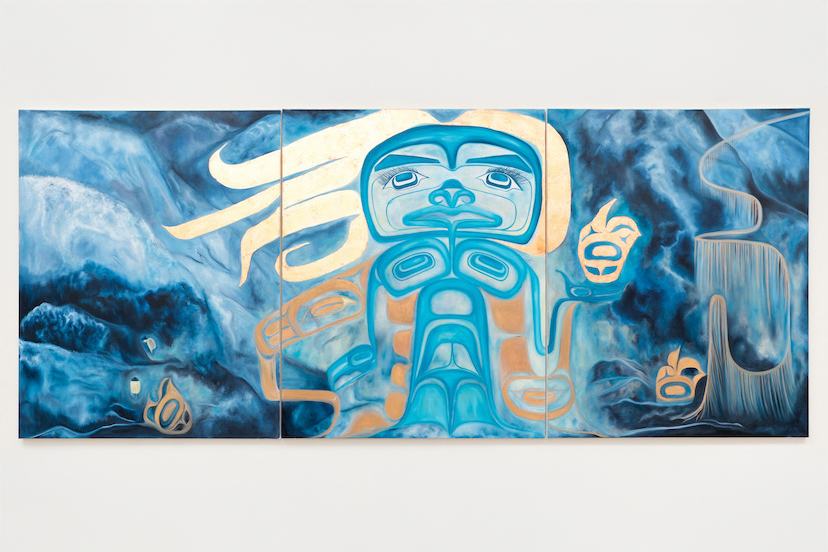
The Healer, 2024, Oil on canvas, 72 x 48 in.
This painting symbolizes a near-death experience I had a few years ago. At that time, I was drowning in grief and felt lost. While it doesn’t feel right to share this story in its entirety, I will mention that this experience involved s’axt (devil’s club). This is considered a very powerful medicine for many nations, including our own. The interaction I had with this medicine was utterly terrifying, but it ultimately liberated me. This medicine opened the door to true healing and set me on a trajectory in life that has transformed me into a straight arrow, meaning I am now living a life that no one can take away from me. This arrow is symbolized in the mouth of the being at the bottom of this painting, representing the spirit of the s’axt (devil’s club). The large being has wings beneath their hands, symbolizing that the s’axt (devil’s club) has freed them from grief. If you look closely at the “background,” the elements are moving outward from the s’axt (devil’s club) being, representing poison being released from the body.
For me, releasing “The Healer” into the world marks a new chapter. I am certain that there will be more immense challenges ahead, but at least I carry the wisdom of thes’axt to face them. I hope this painting will evoke serenity for others, as it has for me.

Gold Dust Woman Buries the Diggers’ Hearts, 2025, Oil and copper leaf on canvas, 144 x 48 in.
Emerging from the shimmer and shadow of ancestral memory and intergenerational pain, Gold Dust Woman conjures a reckoning. She is not a symbol of vengeance, but a force of karmic return—an ancient and irresistible embodiment of what happens when the land, the women, and the spirits remember.
This painting brings together the madness of the Klondike Gold Rush and the deeper violences buried beneath its golden shine—particularly those inflicted upon Indigenous women. In this piece, she buries the hearts of the diggers—those who came to extract, consume, and abandon. She does not collect their heads. She takes their hearts. This gesture is not just punishment; it is relational surgery. It is the removal of that which was twisted by greed, entitlement, and desecration. These buried hearts—identical in shape, but situated differently—become echoes, testimonies, and warnings. The act is ceremonial. To mourn Indigenous women’s bodies, made into sites of conquest, transaction, and silence. This work arose from deep research and dreamwork. In one of many shared reflections, it was discovered that many women in the brothels of the Yukon ended their own lives in the aftermath of colonial rupture. Yet these brothels, paradoxically, had also offered some a fragile form of safety. These contradictions live in the layers of this painting.
Gold Dust Woman does not look away from the trail of damage. She is both the elegy and the reckoning. The land around her hums with the memory of stolen gold, poisoned rivers, and vanished kin. Gold Dust Woman rises from that trauma not as victim, but as an elemental power.
Creating this painting was prayer. Ritual was held ever day when creating this work, where sacred medicine and smoke filled the room. In that way, the painting itself is ceremony—it holds rage, grief, and love.
To stand in front of this work is to be asked:
What has been buried here, and by whom?
What must be unearthed to truly heal?
And what happens when the Earth’s daughters reclaim their own mythology?

Self Portrait, 2019, Oil on Canvas, 60 x 48 in.
From behind, the embers emerge from both passion and anger. In the foreground, a human figure stands as the centrepiece. From one foot, they propel from the ground. From the other foot, they are being pressed to the ground by the surrounding walls. The human’s fingers bend, yet they do not surrender. They continue to push the walls, refusing to be confined. The walls may try to contain the being, but they did not know that beings like us cannot be contained. This is a metaphor of the current lived experience that indigenous people face in our institutions. More often than not, to venture into post secondary education means to compromise fundamentally who we are indigenous people. We are constantly surrounded by walls mimicking the nightmares of our grandparents and great grandparents. It continues to perpetuate a history of assimilation and colonial genocide. “Self Portrait” is both a reflection and a statement: That though the contemporary colonial project continues to assume supremacy over indigenous people, this being resiliently pushes forward without requesting permission to speak.